Yes — before you can register a DBA (Florida calls it a "fictitious name"), state law requires you to advertise the name at least once in a newspaper in the county where your business is based. The ad usually costs $30–$150, the state registration is $50, and you certify on the application that the ad ran. It's real, it's from 1990s-era statute, and skipping it is technically a misdemeanor.
The first time I registered a fictitious name, I assumed I'd misread the instructions. A newspaper ad? In this economy? But there it is in Section 865.09, Florida Statutes: advertise first, register second. I operate several brands under one LLC, which means I've now been through this odd little ritual more times than I'd like — so here is everything I know about it, in the order you actually need it.
Which paper runs it, and what it costs, is a county question — jump to your county, or read on for the whole thing in order.
What the law actually requires
If you do business in Florida under any name that isn't your own legal name — or isn't the exact registered name of your LLC or corporation — you must register that operating name with the Florida Division of Corporations. And before you file that registration, the statute says the name must be "advertised at least one time in a newspaper as defined in chapter 50" in the county where your principal place of business sits.
Three details in that sentence do the heavy lifting:
- At least one time. One insertion, one day. Not a run of weeks like a probate notice — a single ad satisfies the statute.
- "A newspaper as defined in chapter 50." Not any publication — one that meets Florida's legal-notice standards. In practice, most counties have one or two papers everyone uses for this, and their classified desks quote "fictitious name notice" pricing without you needing to explain anything.
- The county of your principal place of business. Your home county if you work from home. Where the business actually operates, not where you'd like it to.
The right order of operations
- Check the name is available. Search the state's fictitious name records on Sunbiz first. Registration doesn't reserve a name (more on that below), but you don't want to build a brand on one that's taken.
- Find your county's legal-notice newspaper. Search "[your county] fictitious name notice" — the paper that comes up doing this every week is your paper.
- Run the notice once. The paper will have a standard format; you supply the fictitious name, the owner's legal name (you, or your LLC), the county, and the statement of intent to register.
- File the registration on Sunbiz. $50, online, usually processed fast. The application has you certify the ad ran — the state does not ask for the clipping.
- Keep the affidavit. The paper sends proof of publication. The state never asks for it, but your bank might, and future-you will want it in the records folder.
That's genuinely all of it. The whole thing is more phone calls than difficulty — the classic Florida-paperwork combination. (Full disclosure: those phone calls are also a service I sell — $75 flat, any Florida county, and I handle steps two and three while you keep your afternoon. The rest of this article tells you everything you need to do it yourself, because that's the deal here.)
What the notice looks like
NOTICE OF INTENT TO REGISTER FICTITIOUS NAME: Notice is hereby given that the undersigned, [owner's legal name], of [address], in the County of [county], intends to register the fictitious name "[YOUR BUSINESS NAME]" with the Florida Department of State, Division of Corporations, pursuant to Section 865.09, Florida Statutes.
What it costs, all-in
- The newspaper notice: $30 to $150, varying by county and paper. Small-county weeklies sit at the bottom of that range; metro dailies at the top.
- The DBA registration on Sunbiz: $50 flat, paid to the state.
- Renewal: the registration lasts five years, expiring December 31 of the fifth year, and renews for another $50. No newspaper ad required at renewal — the ritual is a one-time hazing.
Which paper qualifies is a county question, so I've written up every county — the paper that runs the notice there, which others also qualify, and how often it prints. Start with yours:
Miami-Dade · Broward · Palm Beach · Hillsborough · Orange · Duval · Pinellas · Lee · Polk · Brevard
The $275 letter in your mailbox
Know those numbers before your mail does, because something is coming. File a fictitious name in Florida and your filing lands in a public feed within days — and companies scrape that feed to mail you an official-looking invoice for the publication step.
Here's one that arrived at my house, dated July 28, 2026, for a DBA I'd just filed. $275.00.
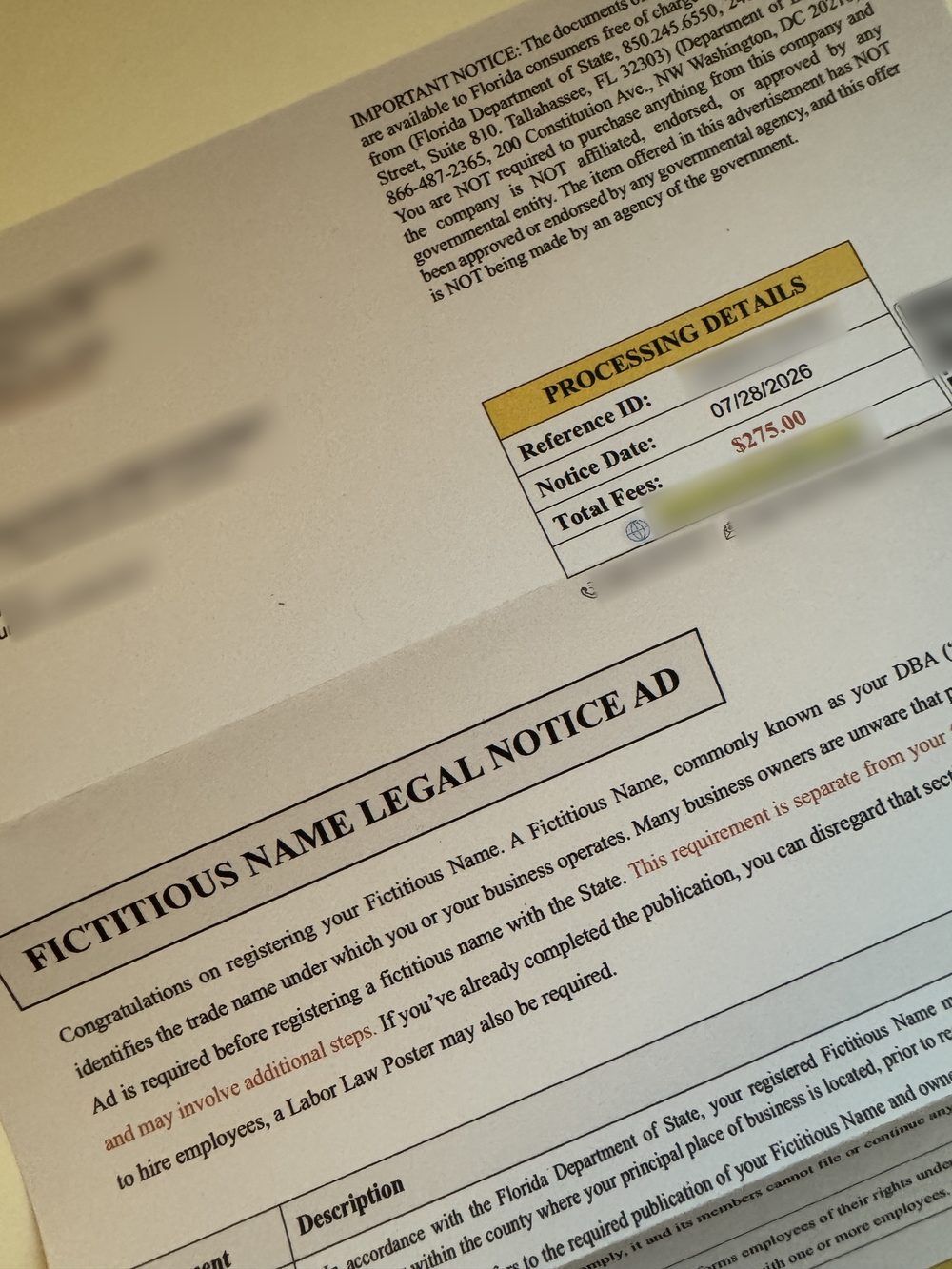
Notice what it does and doesn't say. It is not a scam in the prosecutable sense — read the fine print and it tells you plainly that the company is not a government agency, has no government endorsement, and that you are not required to buy anything. It's an ad. The trick is everything around that disclaimer: a "Reference ID" and a "Notice Date" in a box labeled Processing Details, a Tallahassee return address, a total that reads like an amount due. Nothing about the layout says "advertisement." Everything about it says "invoice." And it slipped in an upsell for a labor law poster while it had my attention.
Strip off the packaging and what's actually for sale is the legwork: working out which paper in your county qualifies under Chapter 50, getting the notice submitted in the format that desk wants, and coming away with the affidavit of publication for your file. That work is real — it's most of this article. But the ad underneath it costs $30–$150, which puts the markup north of $125, aimed at someone who filed last week, has no idea what the ad costs, and is holding a page engineered to feel overdue.
$75, not $275.
You can handle these steps on your own — that is most of this article. I'll submit it properly for you instead: the right paper, the right format, affidavit emailed once it runs. $75 flat*, any of the 67 counties — $200 less than the letter, for the same finished result.
*$100 in Miami-Dade and select counties, where the qualifying newspaper costs more. Each county page shows its own price.
See the DBA Publication ServiceThe parts nobody tells you
Nobody checks the ad — but skip it at your own risk. The application is self-certified; no proof of publication is filed. It's tempting to conclude the step is optional theater. Here's the honest counterweight: operating under an unregistered fictitious name is a second-degree misdemeanor, and — the part with actual teeth — the statute bars your business from maintaining a lawsuit in Florida courts until you've complied. The day you need to enforce a contract is a bad day to discover your paperwork shortcut.
Registration protects nothing. This surprises almost everyone: a fictitious name registration is not a trademark, and it doesn't reserve the name. Florida will happily register the same fictitious name to multiple businesses. It's public notice of who's behind a name — consumer protection pointing at you, not brand protection pointing at competitors. If the name matters commercially, trademark is a separate conversation.
A DBA is not an entity. No liability protection comes with it. If you're a sole proprietor with a registered fictitious name, you're still personally on the hook for everything. The DBA changes what you're called, not what you are. If you want the protection as well, that is a separate filing — forming an LLC — and it comes first, because a fictitious name is a name your LLC trades under.
The five-year clock isn't the only one running. A fictitious name renews every five years — easy to forget precisely because it's so rare, and it's a $50 state fee with no newspaper notice this time, not a repeat of the first step. I file the renewal too. If that DBA sits under an LLC, the shorter clock is the one that bites: the LLC owes Florida an annual report every year between January 1 and May 1, even if nothing about the business changed, and missing the deadline triggers an automatic $400 late fee. Registering the name is the one-time errand. Keeping the entity underneath it in good standing is the recurring one. I file the annual report for you each January, when the state opens the window.
The bank is the real enforcer. Long before any statute catches up with you, a bank will refuse to open an account in your trade name without the registration. If you want checks written to your brand instead of your personal name, this is the actual reason you're doing all this.
Do you even need a DBA?
You need one if the name customers see isn't the name on your formation documents. The common cases:
- Sole proprietor using any business name. Jane Smith running "Coastal Cleaning Co." needs to register it. Jane Smith running "Jane Smith" does not.
- An LLC operating brands beyond its legal name. This is my situation — one LLC, several distinct brands, each one a registered fictitious name. It's a clean way to run multiple small businesses without paying for multiple entities, with the honest caveat that they all share one liability pot.
- A corporation or LLC shortening or restyling its name. "Sunshine Ventures of Tampa Bay LLC" doing business as "Sunshine Ventures" technically needs the registration for the short version.
Common questions
Which newspapers qualify for Florida fictitious name publication?
Any newspaper that meets Florida's Chapter 50 legal-notice standard, in the county where your principal place of business sits — not any publication you'd find on a newsstand. In practice, most counties have one or two papers everyone uses for this, and their classified desks quote "fictitious name notice" pricing without you needing to explain anything. Don't work backward from the statute — I've already written up which paper runs these notices in each Florida county, including the alternates that also qualify. Find yours, then call that paper's legal-notice desk; they do this every week.
Can the ad run online instead of in print?
Chapter 50 has modernized: qualifying papers can carry legal notices on their websites, and counties without a qualifying newspaper have alternate routes. In practice, don't start from the statute — call the legal-notice desk of the paper your county already uses and let them tell you how they run fictitious name ads. They do this every week.
I got a letter asking $275 to publish my DBA. Is it a scam?
It's an advertisement, not a bill, and not from the state. The legitimate ones say so in fine print you have to hunt for — not a government agency, no endorsement, nothing you're required to buy. A company pulled your filing out of the public record and mailed you something shaped like an invoice. You're allowed to hire someone for this step, but know the number first: the newspaper charges $30–$150 to run the notice, and the legal-notice desk will quote you in one call.
How long does the whole process take?
The pacing item is the newspaper: many legal-notice sections publish weekly, so you may wait a few days for the next insertion date. Once the ad has run, the Sunbiz filing is same-day online. Plan for one to two weeks end to end and you'll usually beat it.
Do I need a lawyer for this?
For a routine registration, no — it's administrative paperwork, and this article is experience talking, not legal advice. If your situation has real wrinkles (trademark questions, disputes over a name, multi-state operations), that's when paying for an hour of an actual attorney's time is money well spent.
I already registered my DBA but skipped the newspaper step. Can I publish now?
Yes — run the ad now. The statute wants publication before registration, but a late notice is far better than none: it closes the gap you certified about, and you'll have the affidavit on file if a bank or a courtroom ever asks. Publishing today takes the same one insertion it always did (I can run it for you, including the calls). One honest caveat: if the missed step is already tangled up in an actual dispute, that's an attorney conversation, not a blog-post fix.
What if I have more than one business name?
Each fictitious name is its own registration — its own ad, its own $50, its own five-year clock. There's no bundle discount from the state, which I can confirm from repeated personal experience.
And if the newspaper step is still sitting on your to-do list — I'll handle it for $75, any Florida county, affidavit emailed when it runs.
Where this comes from. The publication requirement is s.865.09, Florida Statutes, which requires the name to be advertised in a newspaper as defined in chapter 50. The $50 state registration fee is from the Division of Corporations’ fictitious name fee schedule, which also prices renewal at $50. Newspaper costs are what the papers themselves quoted me, county by county, and they move. Checked 3 October 2026.
The Honest Founder is a document filing service, not a law firm, and nothing here is legal or tax advice. Rules and fees change. Confirm anything you are relying on against the source itself before you act on it.